Many rural communities across Washington currently face major challenges accessing healthcare. With too many obstacles and not enough physicians, some counties have no primary care doctors at all. And because nearly all residency programs are located west of the Cascades, most new physicians never train, let alone stay, in the communities that need them most.
With support from Premera’s Rural Health Initiative, a family medicine residency was launched in 2023 to change that. Created through a partnership between Pullman Regional Hospital and Washington State University’s Elson S. Floyd College of Medicine, the three-year program’s first class of residents is still completing the three-year program, but it is already having an impact — on local patients and the doctors who care for them.
A long‑term vision on a long road
Program Director Dr. Stephen Hall traces the original idea back more than a decade. At the time, he was teaching medical students through a partnership between WSU and the University of Idaho connected to the Idaho WWAMI program. As the curriculum expanded from one clinical year to two, he was tasked with exposing students to the challenges of rural practice, including field visits to communities with limited resources.
One of those trips got Hall thinking. “We went up to Colville so the students could see what it’s like to practice in an even smaller place,” he said. “We’re doing a tour, and they introduce me to residents.” He never expected to see residents training in that sort of setting. The idea that a small community hospital could support graduate medical education was a revelation. “I looked at the resources they had and thought, this is great — but in Pullman, we can do it better. We have so much more to offer.”
He also knew why it mattered. After years of watching his students leave for residencies in other parts of the country, and stay there, the stakes were clear. “Seventy percent of doctors work within 100 miles of where they do their residency,” he said. He believed strongly that a program in Pullman would mean more physicians staying in the region.
The road wasn’t easy, however. After multiple starts and stops over 11 years, WSU eventually approached Pullman Regional about hosting all three years of training rather than just two. That created a viable path, but not the funding. “The two biggest things that happened were a grant from Premera and then a Health Resources and Services Administration (HRSA) grant,” Hall said. “Without either of those, there’s no residency.”
Why WSU?
For residents Dr. Mohammed Younes and Dr. Jeff Ward, members of the program’s inaugural class, WSU offered something they couldn’t find in larger residencies.
Younes said he discovered the program “by accident” at a national conference. He was looking for a residency with a hospital that was focused on one practice area rather than several competing specialties, and one that would prepare him to deal with a wide variety of cases. Or in his words, “a program where when I finish in three years you can drop me anywhere in the United States and I will feel comfortable practicing medicine.”
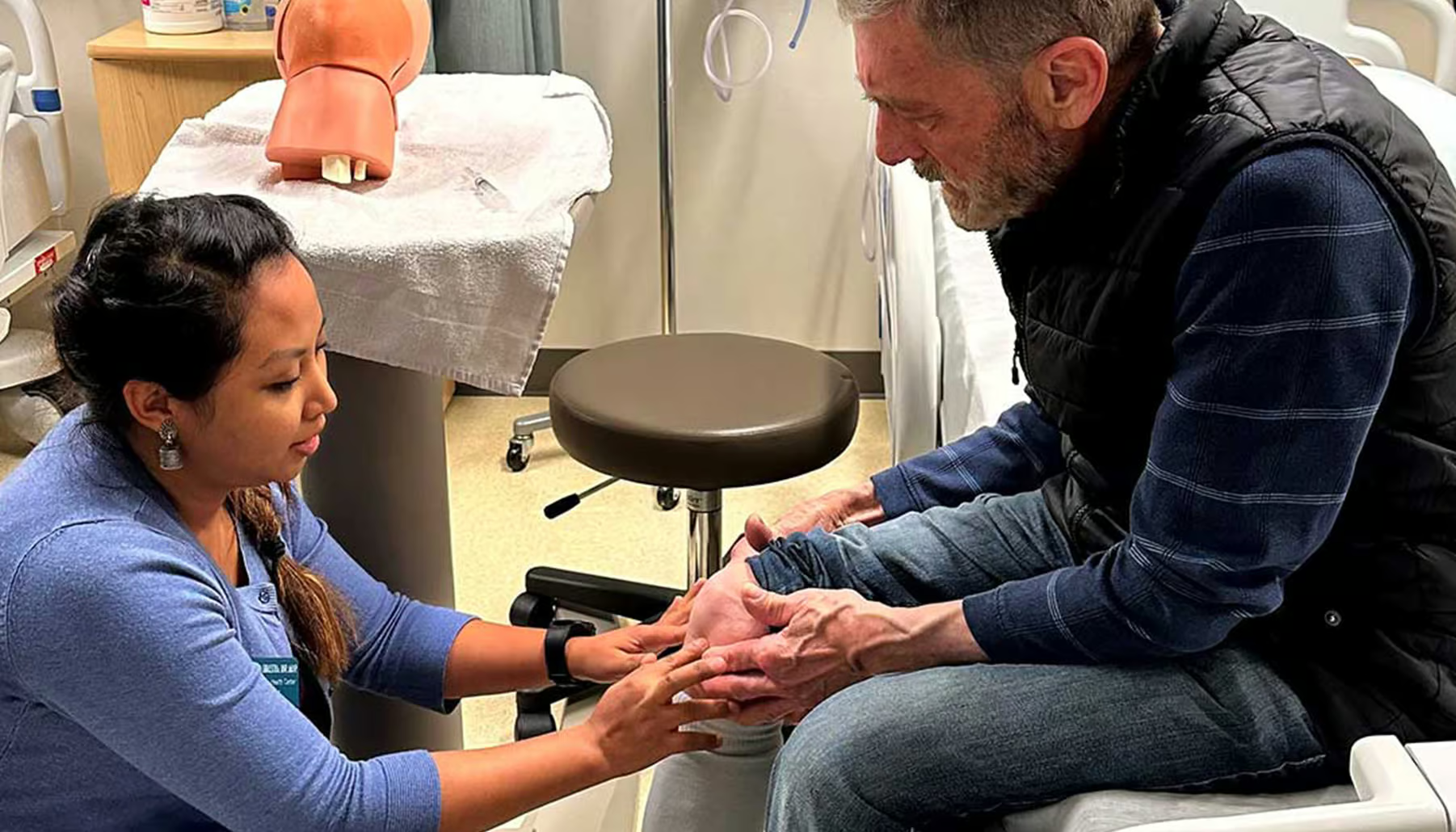
Younes also noted that at Pullman he has to deal with conditions that might be handled by a specialist if he were practicing at a larger hospital, and that gives him valuable skills. “We’re getting that experience hands-on here in our training, which is exactly what I was looking for,” he said.
Ward had similar reasons behind his choice. “I wanted somewhere I could get a full spectrum of training,” he said. He saw what he was looking for in WSU’s program, but the in-person tour revealed even more. “I was really impressed. There was so much collaboration going on and you have so many people who are willing to help you. It’s just a different learning environment, and I feel like that’s for the better.”
Connecting with community
As for whether the program will keep doctors in the region, the early signs are encouraging. Ward said the residency has connected him to a rich, new professional network. “You develop relationships with so many people in the healthcare community here that it’s very appealing to stay just because of the relationships you have, the mentorships you have,” he said.
He also noted how quickly he became connected to the people he served. “When you’re in a community like this, you’re kind of taking on a leadership role without even wanting to. And you feel like your family is a part of the community. That’s something that doesn’t happen when you’re in a city of 500,000 people.”
For Younes, the residency might even be called life-changing. His intention when he started was to return home to Canada when he was done, but things don’t always go as planned. “After being in the [program] for over two years, I’m happy to say I’m in talks with the hospital about taking a job here after residency,” he said. “I think that’s a huge success. And it shows what having residency programs in places like Pullman can do for these communities.”
A model for rural Washington
Another sign of success is that the idea may be spreading, with WSU advising other rural hospitals interested in building similar programs. “Honestly, you don’t have to sell hospitals on [the idea],” said Libby Manthei, Senior Development Director at WSU’s College of Medicine. “More people want it. They’re just scared about how to fund it. So that is where we are looking at joint funding opportunities with the hospitals that we try to approach and bring in that collaboration.”
Hall believes the program can grow, because he’s seen how far it has come, and how far the residents have come as well.
“I remember them walking through the door the first day and thinking to myself, how in the world are we going to get there?” he said. A few years later, the progress is obvious. “Just watching them be mentors and teachers to the first-years, and taking on the complicated cases that they would have had no idea what to do with two and a half years ago, that’s the payoff. I’m just so proud of these guys and the doctors they are. I would take my family to them in a heartbeat. They’re good doctors. They’re good people.”